
Term Ends with Empty Lecture Halls
Some thoughts on the usual non-attendance of the last week of term.

It’s the last week of term. Deadlines are crunching. And student stress is running at an all-time high. And with that, teachers the campus over, are experiencing the usual attendance drop as their students prioritise their deadlines.
This time of year, always makes me reflect on attendance, and more specifically on the frustrating feeling I get when I know there will be more people watching my recorded lecture, than turning up to the real thing.
This is not an ego thing. I know I’m a reasonable lecturer- so when the last-week-of-term lecture’s attendance figures barely makes double figures, I know its not entirely down to my terrible teaching… but I must admit it doesn’t feel great.
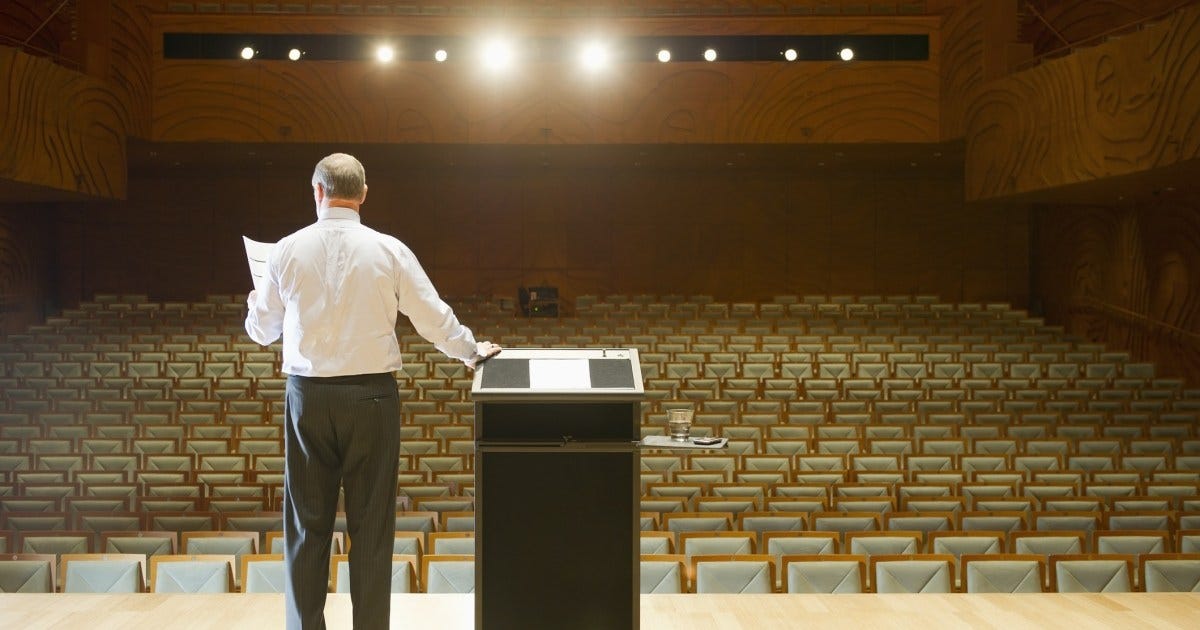
It mostly doesn’t feel great because it impacts those who do attend. I’m a big believer that learning at university is about doing so in community. It’s a social activity- not an isolated endeavour. And when that community doesn’t show up together, those that do, begin to question why they should continue bothering. And it takes a special kind of motivation to keep it up – knowing that whilst others are sacking it off at home, you’re juggling your deadlines, and feeling the same pressure, but also getting yourself to campus, in all weathers, and at antisocial times- to continue attending.
Recording lectures has brought with it loads of positives. You can re-listen to explanations. You can use it to enhance your live scrawled lecture notes. And you can catch up more easily if you can’t make it. And I appreciate the EDI advantages to this model too. But when it becomes more convenient to watch the recording, than show up, I worry sometimes we have the balance wrong.
I remember, many moons ago, when I was a student. Lecture notes were taken down with pen and paper. Lecture halls were (comparatively) full, and if you missed lectures, you caught up by the (sometimes terrible…) lecture notes and readings of your peers. It wasn’t perfect, but it did incentivise showing up. And it did force you to be accountable to how you used your time, so to prioritise your attendance.
Today, universities spend lots of money on attendance monitoring systems and enforce these systems through a litany of QR coded attendance registers. The data we have on student attendance is granular, with every QR code scan, Moodle page click, and online-resource engaged with, logged, monitored and turned into a metric of performance.
And these systems reveal a usual curve of semester attendance- one that’s high at the beginning of the year, and which gradually declines throughout the semester to its lowest point at the end of semester (typically when coursework deadlines fall). Perhaps more strikingly, despite all teaching being compulsory, attendance for each session rarely hits above 70%, and it declines to an average of 40% in the last week of term.
I’m not of the tradition of forcing attendance. Or removing lecture recordings to make harder for students to access learning. Why? Because it’s not my job to force you to attend. Students live busy lives juggling lots of outside commitments like care and work, which I know makes studying more challenging. But I do think we need to change our working expectations of attendance, at least to enhance the experience of those who do.
Timetabling for example, works on finding rooms that fit the number of students enrolled on the course. And this can make the timetabling of larger (and more popular) modules more difficult as they require larger lecture halls. There are comparatively fewer large lecture halls, than smaller teaching rooms, which places high demand on these mega-lecture hall rooms throughout term. And because of their demand, it also forces larger modules to be timetabled across the full breadth of the timetabled day (9am-6pm). And with larger modules typically delivering ‘core’ or ‘compulsory’ content (which often already suffers motivation fatigue!), this demand means they also face a higher likelihood of being timetabled at 9am, or 5pm. This compounds their likelihood of poorer attendance.
Imagine if we used the data we have on attendance, not only to ‘enforce’ attendance, but also to be more pragmatic with the planning and resourcing of these sessions.
Take for example, in timetabling. A module of 150 students currently needs a room which houses 150 students on the off chance everyone turns up.
But what if instead of assuming 100 % attendance each week, we worked at the more realistic (and data-demonstrated) expectation of ~70% or ~60%?
Might this open up smaller timetabled rooms which are more flexibility accommodated? Would smaller, busier rooms, give a greater sense of intimacy and togetherness for our students? And would the optics of a fuller room, make it less obvious, to attending students, if the usual ~30% didn’t attend.
In a similar vain, what if we didn’t put all of our coursework deadlines in the last week of the semester, but instead moved them to January? This might do away with the material impact of deadline congestion on attendance priorities, and it might even staff a nicer marking-free Christmas break too!
What if we didn’t timetable a lecture-a-week, as per convention, but instead scheduled all of our lectures within the first five weeks of term. Then scheduled smaller seminar/activity/workshop tasks in the last five weeks of term. This might make space for more active learning and participation, which facilitates not only a deeper exploration of module topics, but also higher interaction and engagement value at the exact moment when attendance motivation nose dives.
What if we chose not to shoehorn teaching into unsocial timeslots like 4-6pm, but instead did away with anti-social teaching times completely. This might benefit commuter students, students with caring responsibilities, but also have a positive impact on student and staff - especially when these sessions often follow very full days of teaching and learning activities, and when student concentration is typically the poorest.
There are so many ‘what ifs’ that could make attendance better. But only if we dared to do something differently.
Until we do, I guess I’ll see you next year? Same time. Same place: in my barely full 4-6pm lecture! or at the very least, on my lecture recording, if you choose not to come.
Being on the other side of academia as a PhD student and a TA, it's quite interesting realising just how much goes into a module and how much planning, prep and analysis is needed to make sure the content is shared effectively. Things like timetabling are often out of the hands of the lecturer, and if you're unlikely with your time-slot i.e. 9am or 5pm, you know the attendance will be poor.
I do think recorded lectures has helped a lot with accessibility, though it has also made it easier to just not show up in the first place. Though I imagine, statistics on attendance for modules change a lot depending on subject. I studied Computer Science at Nottingham, and the general vibe there is often remote-working. Whether stereotypical or how many students in CS function. But in other subjects its either more common or expected to show up in person, Medicine being a good example of that.
I do like the idea of timetabling based on 70% attendance, as generally it never seems to exceed that unless it's the first week of term. Though I remember having some lectures in 2nd year where the room was too small, people had to leave because there was literally no space to sit in them. Which would inadvertently motivate students not to show up to begin with. It's a very complicated situation, but it's nice to hear the professor's perspective on it and some ideas on how it could change (if academia didn't move at the pace of a snail 😂).